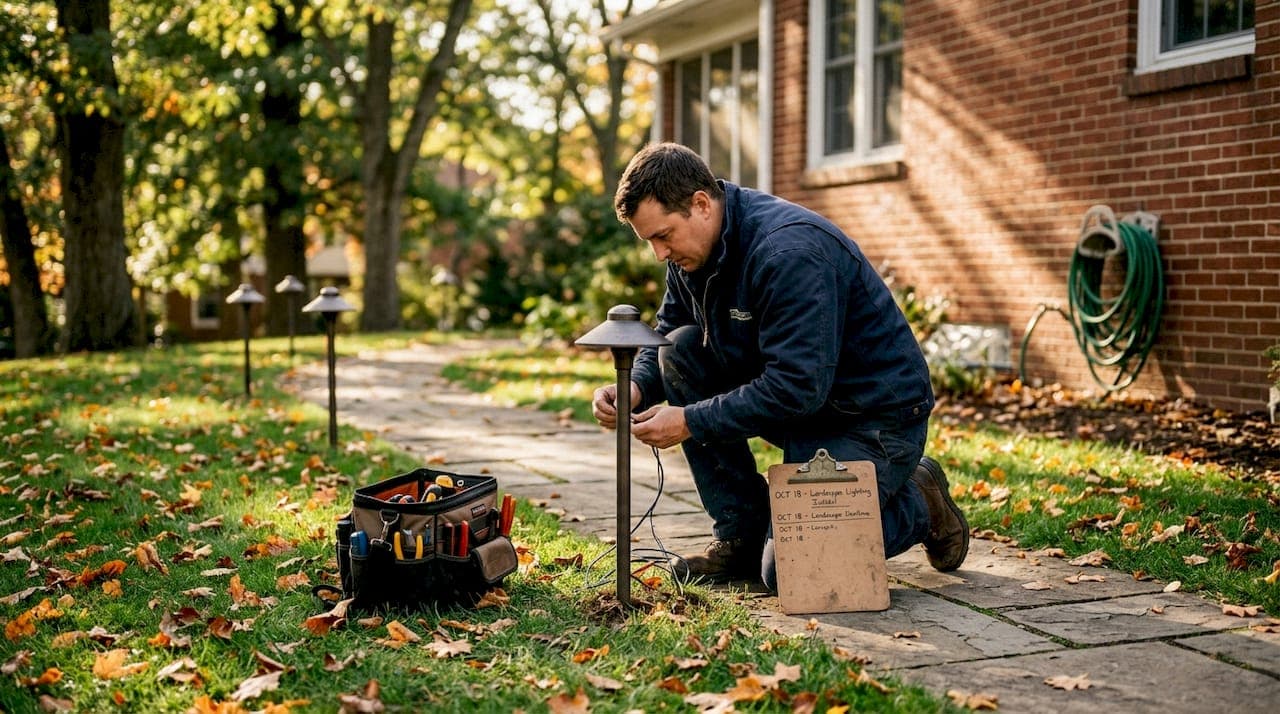
Most Pittsburgh homeowners assume outdoor lighting is as simple as plugging in a few fixtures and calling it done. That assumption leads to overloaded transformers, flooded junction boxes, and code violations that cost far more to fix than a professional installation would have cost upfront. The reality is that a quality outdoor lighting project involves custom design, proper wiring, local permit checks, and climate-specific hardware choices. This guide walks you through every stage of the process, from the first design consultation to final system testing, so you know exactly what to expect and what questions to ask before any work begins.
Table of Contents
- Core stages of the professional lighting installation process
- Low-voltage vs. line-voltage outdoor lighting: Safety and legality
- Pittsburgh-specific regulations, climate, and what homeowners must consider
- Common missteps and pro secrets for a flawless lighting installation
- Why professional lighting design pays off for Pittsburgh homeowners
- Ready to upgrade your Pittsburgh outdoor lighting?
- Frequently asked questions
Key Takeaways
| Point | Details |
|---|---|
| Plan before you install | A professional design consult leads to safer, more attractive, and compliant lighting systems. |
| Low-voltage is preferred | For most Pittsburgh homes, low-voltage is safest, compliant, and rarely requires city permits. |
| Mind local codes and climate | Pittsburgh's permitting rules, weather, and terrain must guide equipment choices and installation methods. |
| Avoid DIY pitfalls | Mistakes like overloading transformers and poor waterproofing can shorten system life and risk safety. |
| Pro installation pays off | Hiring experts means compliant, long-lasting, and high-value results for your property. |
Core stages of the professional lighting installation process
Understanding the landscape lighting stages before your project starts gives you confidence and helps you hold your installer accountable. A professional outdoor lighting project is not a single afternoon task. It follows a structured sequence that protects your property, meets safety codes, and produces results that actually look great after dark.
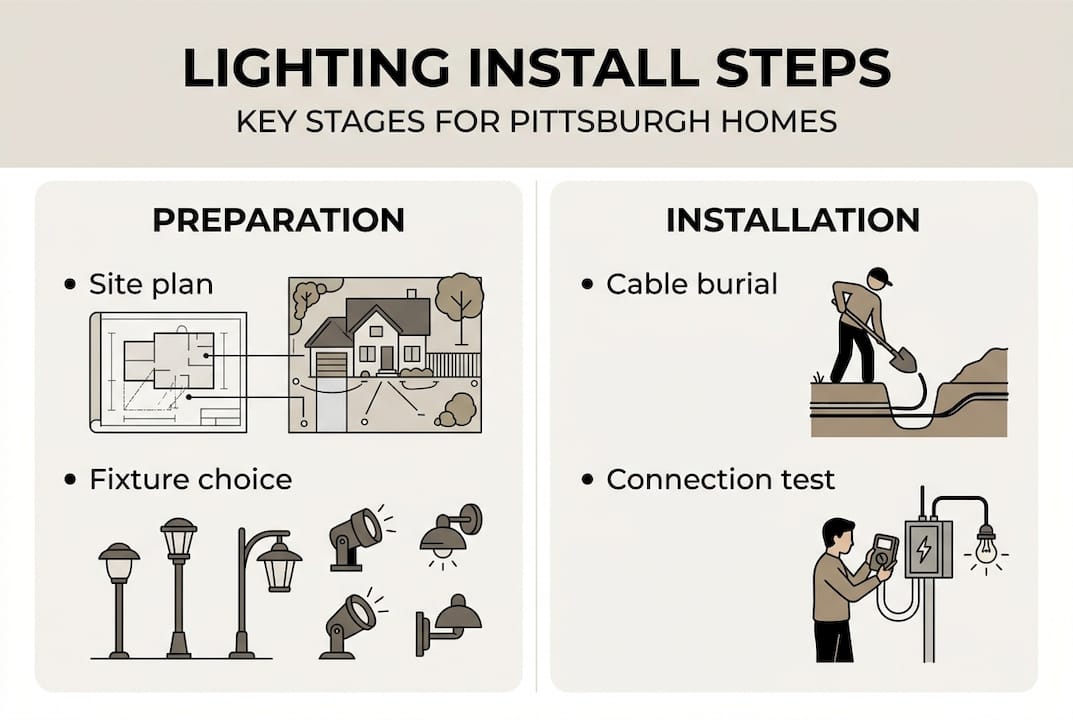
Here is how a typical professional installation unfolds:
- Custom design consultation and layout planning. A lighting designer walks your property, identifies focal points, assesses existing electrical infrastructure, and maps out lighting zones. This step determines fixture types, beam angles, and wiring routes before a single hole is dug.
- Fixture and transformer selection. Based on your property's size and style, the team selects low-voltage path lights, spotlights, and uplights, along with a correctly sized transformer. Weatherproof wiring rated for direct burial is chosen at this stage.
- Trenching and cable burial. Per NEC requirements, low-voltage cable is buried at a minimum of 6 inches, while line-voltage wiring requires 18 to 24 inches of depth. The transformer is mounted near a GFCI-protected outlet.
- Wiring connections and fixture placement. Waterproof wire connectors are used at every junction. Fixtures are positioned and aimed to eliminate glare and hot spots while maximizing coverage.
- System testing, smart controls, and final adjustments. The full installation step details are verified during a live system test. Timers or smart controls are programmed, and the team makes final aiming and brightness adjustments before backfilling trenches.
The standard professional process covers custom design, fixture selection, NEC-compliant cable burial, waterproof connections, and a final smart-control setup, with most mid-size projects completed in just 1 to 2 days.
Pro Tip: Ask your installer to show you the transformer load calculation before work begins. A properly sized transformer running at no more than 80% capacity is the single biggest predictor of a long-lasting system.
Low-voltage vs. line-voltage outdoor lighting: Safety and legality
Once you understand the installation sequence, the next decision is which type of system fits your property. The choice between low-voltage and line-voltage lighting has real consequences for safety, cost, and legal compliance.
Low-voltage (12V) systems use a transformer to step down standard household current. They are safer to handle, far less likely to cause injury if a wire is accidentally cut, and in most Pittsburgh neighborhoods they do not require a city permit. This makes them the default choice for curb appeal lighting projects like path lights, garden uplights, and roofline accents.
Line-voltage (120V) systems deliver more raw power and are used for high-output fixtures like large architectural floodlights. However, they require a licensed electrician, a city permit, and a formal inspection before the work is considered legal.
Here is a side-by-side comparison to make the decision easier:
| Feature | Low-voltage (12V) | Line-voltage (120V) |
|---|---|---|
| Safety risk | Low | High without proper install |
| Permit required (Pittsburgh) | Usually not | Yes, via OneStopPGH |
| Burial depth required | 6 inches | 18 to 24 inches |
| Licensed electrician needed | No | Yes |
| Best use case | Paths, gardens, accents | Large floodlights, commercial |
| GFCI protection required | Yes | Yes |
Regardless of which system you choose, outdoor lighting codes require GFCI protection on all exterior circuits and wet-rated fixtures wherever moisture exposure is possible. These are not optional upgrades. They are legal requirements.
The key safety standards for residential outdoor lighting specify 6-inch burial depth for low-voltage cable and 18 to 24 inches for line-voltage, with GFCI protection mandatory on all outdoor circuits.
For most Pittsburgh homeowners, low-voltage is the smarter path. It is safer, more flexible, and the benefits of professional lighting are fully achievable without ever touching line-voltage infrastructure.
Pittsburgh-specific regulations, climate, and what homeowners must consider
National codes set the floor, but Pittsburgh adds its own layer of considerations. Local terrain, seasonal weather, and city permitting rules all shape how outdoor lighting should be planned and installed here.
Permit requirements in Pittsburgh:
- Low-voltage landscape lighting is typically exempt from city permits
- Any line-voltage or electrical panel modification requires a permit through OneStopPGH
- HOA communities may have their own rules about fixture brightness, color temperature, and placement
- Light pollution ordinances in some Pittsburgh neighborhoods restrict upward-facing fixtures
Pro Tip: Before installation begins, check with your HOA and review Pittsburgh's zoning map for any light-spillage restrictions. A five-minute check now prevents a costly fixture swap later.
Pittsburgh's freeze-thaw cycles are a real threat to outdoor lighting hardware. Water infiltrates poorly sealed connectors in fall, freezes in winter, and expands until the connection fails. Hilly terrain also creates drainage challenges, meaning trenches on slopes need careful waterproofing at every low point.

Here is a quick reference for what triggers inspection or approval in western PA:
| Scenario | Permit or inspection needed? |
|---|---|
| Low-voltage path lights and uplights | No |
| New outdoor GFCI outlet installation | Yes |
| Line-voltage floodlight wiring | Yes |
| HOA-governed property, any lighting | HOA approval likely needed |
| Panel upgrade for outdoor circuits | Yes |
For professional design features that hold up in Pittsburgh's climate, look for fixtures rated IP65 or higher, connectors with silicone-filled waterproofing, and UV-stable housing materials. These details separate a system that lasts 20 years from one that needs repairs every spring.
If you are adding motion-activated lighting to your project, confirm that the sensors are rated for the temperature range Pittsburgh experiences, which can swing from below zero to 90 degrees Fahrenheit within the same calendar year.
Common missteps and pro secrets for a flawless lighting installation
Even well-intentioned homeowners and some inexperienced contractors make the same preventable errors. Knowing these mistakes in advance saves you money, frustration, and potential safety hazards.
The most common outdoor lighting mistakes:
- Overloading the transformer beyond 80% of its rated capacity, which causes flickering, overheating, and early failure
- Using non-waterproof wire connectors that corrode within one Pittsburgh winter
- Burying cable too shallow, leaving it vulnerable to lawn equipment and frost heave
- Placing fixtures too close together, creating glare and washed-out hot spots instead of depth and drama
- Skipping the HOA approval process and then having to remove newly installed fixtures
- Ignoring voltage drop on long wire runs, which makes distant fixtures noticeably dimmer than those near the transformer
"The most common failures we see are poor waterproofing, undersized wire gauge, and glare from misaimed fixtures. Every one of these is avoidable with proper planning."
Voltage drop is worth a closer look. On a run longer than 100 feet, the voltage reaching the last fixture can drop enough to change the color and brightness of the light noticeably. Professionals solve this with a loop wiring layout or by upsizing the wire gauge on long runs. DIYers rarely account for this, and the result is a system that looks uneven from day one.
For Pittsburgh winters specifically, store any fixtures not rated for freezing temperatures before the first hard frost. Fixtures with an IP65 or higher rating are built to handle moisture and cold, but cheaper hardware will crack, flood, and fail.
Pro Tip: Run a voltage meter test at the last fixture on each wire run before burying cable. If the reading is below 10.8V on a 12V system, upsize your wire or shorten the run before you backfill.
Why professional lighting design pays off for Pittsburgh homeowners
Here is something most online guides will not tell you: the real cost of a DIY outdoor lighting project is not the fixtures or the wire. It is the three to five years of repairs, replacements, and frustration that follow a system built without professional design knowledge.
We have seen it repeatedly. A homeowner spends a weekend installing path lights, feels great about the result, and then spends the next two springs replacing corroded connectors and re-aiming fixtures that shifted during frost heave. The upfront savings evaporate fast.
A professionally designed system, built with correctly sized transformers, IP65-rated fixtures, and NEC-compliant burial depths, routinely lasts 15 to 25 years with minimal maintenance. That longevity is not a marketing claim. It is the direct result of doing every step correctly the first time.
Beyond durability, professional design delivers something DIY simply cannot: layered lighting that actually enhances your property's architecture. Uplighting a mature tree at the right angle, washing a stone facade with the right color temperature, and framing a front walkway with fixtures at the right spacing are design decisions that require experience. The difference between a well-designed system and a DIY attempt is visible from the street.
For Pittsburgh homeowners, quality outdoor lighting also adds measurable property value. Studies consistently show that strong curb appeal translates to higher sale prices and faster transactions. A professionally installed system is an asset, not just an amenity.
Ready to upgrade your Pittsburgh outdoor lighting?
If this guide has made one thing clear, it is that outdoor lighting done right requires planning, the correct hardware, and knowledge of Pittsburgh's specific climate and code requirements.

At Myriad Lighting, our team of landscape lighting experts handles every stage, from the initial design consultation to final system testing, with hidden wiring and minimal disruption to your yard. Whether you are upgrading your curb appeal, adding safety lighting, or exploring holiday lighting solutions for the season, we bring the design experience and local knowledge to get it right. Reach out today to schedule your consultation and see what a professionally designed system looks like on your property.
Frequently asked questions
How long does a professional outdoor lighting installation take in Pittsburgh?
Most mid-size installs take 1 to 2 days, depending on project complexity, property size, and weather conditions on the day of installation.
Do I need a permit for outdoor lighting in Pittsburgh?
Low-voltage systems usually don't require permits, but line-voltage installations need city approval through the OneStopPGH portal before work begins.
What is the safest type of outdoor lighting for homes?
Low-voltage (12V) lighting is the safest option for residential yards, significantly reducing electrical hazard risks compared to line-voltage systems.
What maintenance does outdoor lighting need for Pittsburgh winters?
Choose LED fixtures rated IP65 or higher for wet and cold conditions, and store any non-weatherproof components before Pittsburgh's freeze-thaw cycles begin in late fall.
How can I avoid common outdoor lighting installation mistakes?
Hire a professional installer, use wet-rated fixtures, avoid overloading your transformer, and follow NEC burial and connection codes from the start.