
Most Pittsburgh homeowners think outdoor lighting is simple: buy a few fixtures, screw them in, and call it done. But professionally installed systems yield 20-50% ROI on property value, and enhanced lighting has been shown to reduce nighttime street crimes by 15% and gun violence by 21% in urban neighborhoods. That's not decoration. That's a real investment in your home, your family, and your block. The difference between a lighting system that delivers those results and one that fades out after two winters comes down to one thing: quality. In fixture materials, in design, and in installation.
Table of Contents
- Why fixture quality matters for performance and longevity
- The impact of professional design and installation
- Common failures of low-quality outdoor lighting
- Balancing aesthetics, safety, and environmental responsibility
- Our take: Why most homeowners underestimate outdoor lighting quality
- Take your Pittsburgh home to the next level with quality outdoor lighting
- Frequently asked questions
Key Takeaways
| Point | Details |
|---|---|
| Quality maximizes returns | Investing in high-quality fixtures and professional design can raise your property value and reduce crime risk. |
| Performance starts with materials | Durable, certified lighting resists Pittsburgh’s weather and saves on energy and repairs. |
| Smart design boosts beauty and safety | Expert installation delivers curb appeal, better coverage, and peace of mind for your family. |
| Balance beauty with responsibility | Use warm color, shielded optics, and Dark Sky features to protect both your home and neighborhood environment. |
Why fixture quality matters for performance and longevity
Not all outdoor light fixtures are built the same, and the gap between a professional-grade unit and a big-box bargain is enormous. The most important measure is luminous efficacy, which tells you how much usable light you get per watt of electricity. Quality fixtures offer high luminous efficacy in the range of 100 to 160 lumens per watt, cutting energy use by up to 80% compared to halogen bulbs. DLC (DesignLights Consortium) standards require outdoor luminaires to hit 115 to 125 lm/W to qualify, so looking for DLC certification is a fast way to confirm a fixture is worth your money.
Beyond energy savings, the lifespan difference is striking. Professional-grade LEDs routinely last 50,000 hours or more, while economy plastic units from discount stores often fail within one to two years. Pittsburgh winters are hard on outdoor fixtures. Freeze-thaw cycles, ice, and humidity punish low-grade housings quickly.
| Feature | Economy fixtures | Professional-grade fixtures |
|---|---|---|
| Lifespan | 1-3 years | 15-25+ years |
| Efficacy | 60-80 lm/W | 100-160 lm/W |
| CRI rating | Below 70 | 80+ |
| Warranty | 90 days to 1 year | 5-10 years |
| Weather rating | Often unrated | IP65 or higher |
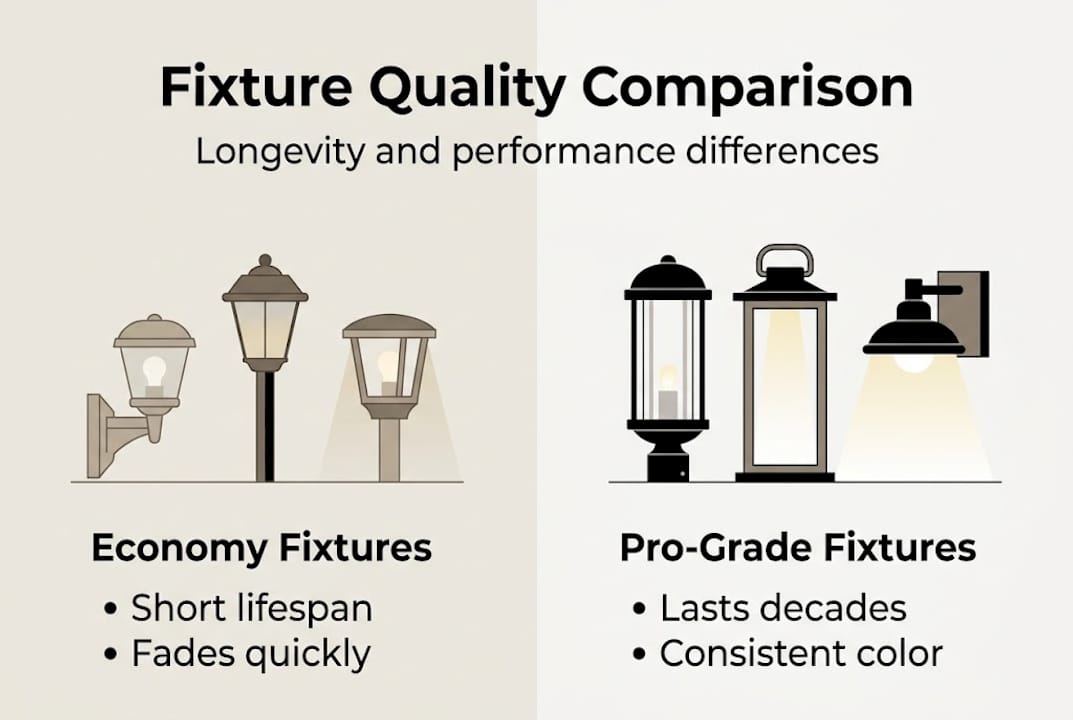
CRI, or color rendering index, is another spec that matters more than most homeowners realize. A CRI above 80 means colors look natural and accurate under the light. Landscape plantings, stone facades, and architectural details all look flat and washed out under low-CRI fixtures. Mechanics favor LEDs with CRI above 80 and efficacy above 130 lm/W, and avoid cheap plastics that are prone to failure in one to two years compared to professional-grade units with up to 25 times the lifespan.
Thermal management is the quiet factor most buyers miss entirely. Heat is the enemy of LED longevity. Quality fixtures use aluminum housings and engineered heat sinks to pull heat away from the LED chip. Cheap units trap heat, which accelerates lumen depreciation and shortens life dramatically. Avoiding common outdoor lighting mistakes starts with reading the spec sheet before you buy.
Pro Tip: When evaluating any outdoor fixture, look for three things on the spec sheet: DLC listing, IP65 or higher weatherproof rating, and a minimum five-year warranty. If any of those are missing, keep looking. High-performance LED flood lights are a useful benchmark for what good specs look like in practice.
The impact of professional design and installation
Even the best fixture underperforms when placed in the wrong spot or wired incorrectly. Expert design is what turns individual fixtures into a cohesive system that works. A professional lighting designer maps your property for coverage, eliminates dark zones, and layers light sources to create depth and visual interest that no single fixture can achieve alone.
The financial case is compelling. Professionally installed systems yield 20-50% ROI on property value, and the crime reduction data from a Philadelphia study shows a 15% drop in nighttime street crimes and a 21% reduction in gun violence in well-lit areas. For Pittsburgh homeowners, that's not an abstract statistic. It's a meaningful improvement in daily life.
| Factor | DIY installation | Professional installation |
|---|---|---|
| Upfront cost | Lower | Higher |
| Property value increase | Minimal | Up to 50% ROI |
| Repair frequency | High | Low |
| Coverage quality | Inconsistent | Optimized |
| Wiring safety | Variable | Code-compliant |
"Homes with professional lighting see up to 50% return on value and a measurable reduction in neighborhood crime."
Here's what a professional installation process typically looks like:
- Consultation and site walk: A designer evaluates your property's architecture, landscaping, and specific safety needs.
- Custom lighting plan: Fixture placement, beam angles, and color temperatures are mapped before a single hole is drilled.
- Installation with hidden wiring: Cables are routed discreetly to preserve your home's appearance.
- System calibration: Each fixture is aimed and adjusted for optimal coverage and visual balance.
- Final walkthrough: You review the result and request any refinements before the crew leaves.
When you transform your outdoors with a professionally designed system, you're not just adding light. You're adding a layer of security and curb appeal that works every single night. Pairing your system with a motion-activated lighting guide can further strengthen your home's perimeter coverage. For properties with pools, pool lighting for safety is another area where professional placement makes a measurable difference.
Common failures of low-quality outdoor lighting
Cutting corners on outdoor lighting doesn't save money. It just delays the cost and adds frustration. Low-quality fixtures fail through water ingress when they lack proper IP65 sealing, voltage drop on long cable runs, thermal degradation from poor heat management, and lumen depreciation well before the 50,000-hour mark. Solar lights are especially prone to battery wear, which can cut their effective lifespan to under two years.
Pittsburgh's climate is particularly unforgiving. Freeze-thaw cycles crack plastic housings. Ice and standing water work into poorly sealed joints. UV exposure fades cheap finishes and makes brittle plastics even more fragile. A fixture that looks fine in September can be waterlogged and flickering by February.
Here are the most common failure points to watch for:
- Non-IP65 seals: Water gets in, corrodes the driver, and kills the fixture.
- Voltage drop: Long cable runs without proper wire gauge cause dim, inconsistent output.
- Plastic housings: They crack, warp, and discolor within one to two Pittsburgh winters.
- No thermal management: Heat builds up inside the housing and destroys the LED chip early.
- Weak warranties: A 90-day warranty on an outdoor fixture is a red flag, not a feature.
- Solar battery degradation: Budget solar lights often lose 30 to 50% of battery capacity within 18 months.
Avoiding these lighting mistakes to avoid means doing your homework before you buy. If you're evaluating solar options, IP65-rated solar lights represent the minimum acceptable standard for Pittsburgh conditions.
Pro Tip: Always check the IP rating and warranty length before purchasing any outdoor fixture. IP65 means the unit is dust-tight and protected against water jets. Anything below that is a gamble in Pittsburgh's weather. A warranty shorter than three years on a permanent installation fixture is a sign the manufacturer doesn't trust their own product.
Balancing aesthetics, safety, and environmental responsibility
Quality outdoor lighting isn't just about brightness. It's about the right light in the right place at the right intensity. Color temperature, measured in Kelvin, has a huge effect on how your home feels at night. Use 2700 to 3000K CCT for ambiance and safety. That warm white range is flattering for architecture, comfortable for the eye, and less disruptive to wildlife and neighbors than the harsh blue-white tones above 4000K.
Glare is a safety issue that often gets overlooked. A poorly aimed or unshielded fixture can blind a driver or pedestrian just as effectively as no light at all. Precision optics and shielded housings direct light exactly where it's needed without spilling onto neighboring properties or into the sky.
Dark Sky compliance is becoming increasingly important for Pittsburgh homeowners. Over-illumination risks light pollution, and balancing crime reduction benefits with shielded fixtures and timers is the right approach per Dark Sky principles. This isn't just an environmental concern. It's a neighborhood harmony issue. Poorly aimed lights that flood a neighbor's bedroom window or wash out the night sky are a source of real friction.
Pittsburgh is actually ahead of the curve here. The city uses GIS data to plan streetlight placement with neighborhood equity in mind, ensuring that lighting improvements reach all communities fairly. That same data-driven thinking should inform residential projects too.
Key principles for responsible outdoor lighting:
- Warm color temperature: Stay in the 2700 to 3000K range for most residential applications.
- Full cutoff fixtures: Direct light downward and eliminate upward spill.
- Timers and dimmers: Reduce output during late-night hours when full brightness isn't needed.
- Targeted placement: Light paths, entries, and focal points rather than flooding entire areas.
"Great lighting is a blend, not a battle, of beauty, security, and stewardship."
For inspiration on how these principles come together visually, the nightscape lighting tips from Myriad Lighting show how thoughtful design creates stunning results without excess. For properties with water features, ambient pool lighting demonstrates how layered warm light transforms outdoor spaces after dark.
Our take: Why most homeowners underestimate outdoor lighting quality
After working on hundreds of Pittsburgh properties, we've noticed a consistent pattern. Homeowners spend weeks researching countertops or flooring, then buy outdoor fixtures based on price alone. The logic seems reasonable: lights are lights. But that thinking costs more in the long run than almost any other shortcut in home improvement.
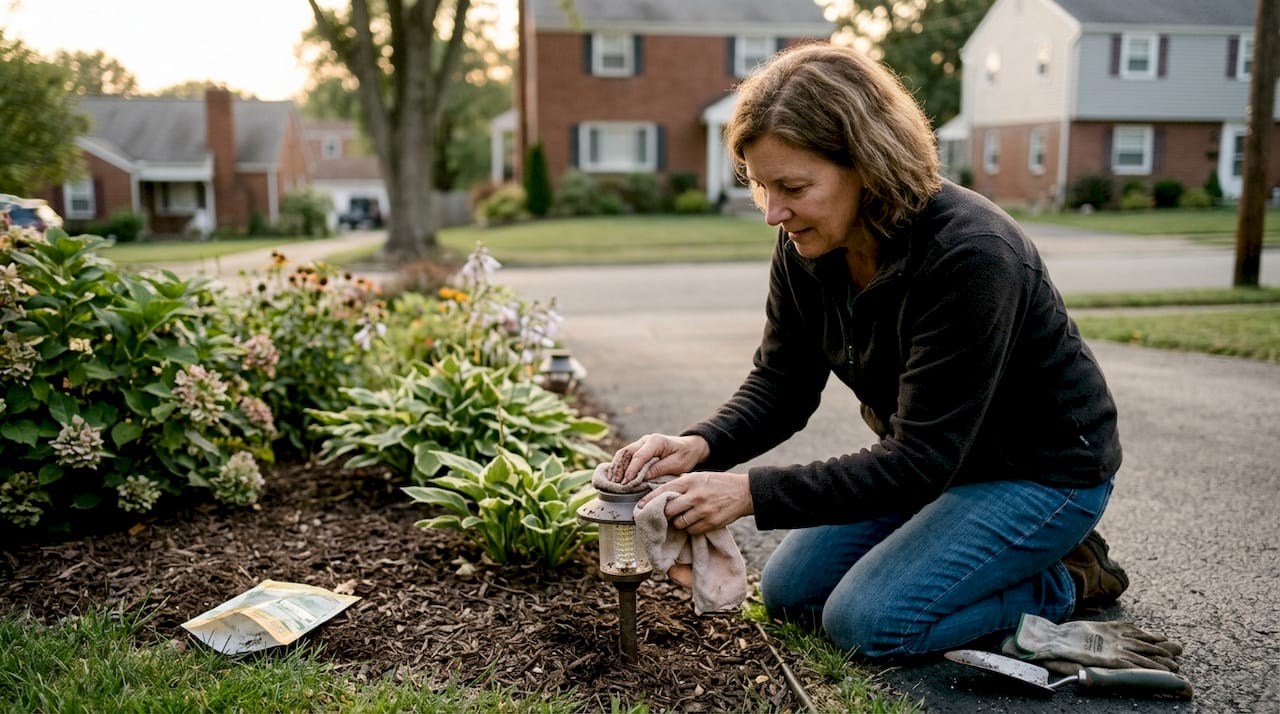
Bargain fixtures disappoint not because they fail immediately, but because they degrade gradually. Brightness drops. Colors shift. Fixtures start to look weathered and cheap. By year three, a homeowner is replacing everything anyway, having spent more total than a quality system would have cost upfront.
The hidden wins in professional lighting are subtle but powerful. Precise placement creates depth and drama that cheap flood lights simply cannot replicate. Advanced controls let you shift the mood from welcoming to secure with a single setting. And community-minded design, using warm tones and shielded fixtures, makes your home a good neighbor rather than a light polluter.
What we wish every Pittsburgh homeowner knew before buying: the fixture is only part of the story. Design, placement, and installation are what make lighting truly work. Investing in illuminating curb appeal means thinking about the whole picture, not just the price tag on the box.
Take your Pittsburgh home to the next level with quality outdoor lighting
You now know what separates a lighting system that performs from one that disappoints. Quality fixtures, expert design, responsible placement, and professional installation are not optional extras. They're the foundation of a system that adds real value to your home and real safety to your family.
At Myriad Lighting, we design and install outdoor lighting for Pittsburgh homes with a quality-first approach that covers everything from roofline and landscape lighting to holiday lighting solutions that make your home stand out every season. Our process starts with a personalized consultation and ends with a system calibrated to your exact property. Ready to see what your home looks like at its best? Get a custom lighting quote and let's build something worth coming home to.
Frequently asked questions
What makes a lighting fixture 'high quality' for Pittsburgh homes?
High-quality fixtures combine high luminous efficacy in the 100 to 160 lm/W range, IP65 or higher weatherproof ratings, CRI above 80, and DLC certification, making them built to handle Pittsburgh's climate while delivering reliable, efficient light for 15 to 25 years.
How does lighting design impact safety around my home?
Expert design eliminates dark zones, deters intruders through consistent coverage, and is backed by data showing professionally installed systems reduce nighttime street crimes by 15% and gun violence by 21% in comparable urban neighborhoods.
Why avoid cheap or non-certified outdoor lights?
Budget fixtures are prone to early failure from water ingress, voltage drop, and thermal degradation, which means more frequent replacements and higher total costs than a quality system installed correctly the first time.
What is Dark Sky compliance and should I care?
Dark Sky compliance uses shielded fixtures, warm 2700 to 3000K temperatures, and timers to minimize light pollution, protecting your neighborhood's character while still delivering the safety and beauty benefits of well-designed outdoor lighting. Over-illumination causes real harm to ecosystems and neighbor relations, so the balance matters.