
Most homeowners focus on what's inside the house and treat outdoor lighting as an afterthought. A porch light here, a floodlight there, and they call it done. But poorly planned outdoor lighting doesn't just look underwhelming. It actively costs you curb appeal, security, and even resale value. Lighting design is the strategic planning and use of light to enhance function, mood, aesthetics, and safety in outdoor spaces. When you get it right, your Pittsburgh home looks polished after dark, feels safer, and stands out from every other house on the block. This article breaks down exactly how to make that happen.
Table of Contents
- Lighting design fundamentals explained
- Common outdoor lighting pitfalls: What to avoid
- Balancing aesthetics and safety: Practical solutions
- Applying lighting design for Pittsburgh homes: A step-by-step approach
- Why less is more: Local insights from Pittsburgh lighting experts
- Transform your Pittsburgh home with expert lighting solutions
- Frequently asked questions
Key Takeaways
| Point | Details |
|---|---|
| Lighting design matters | Purposeful lighting planning enhances both safety and beauty in outdoor spaces. |
| Avoid common pitfalls | Over-lighting, mismatched color, and poor fixture placement can ruin your results. |
| Combine safety and style | Use shielded fixtures and layered lighting for maximum impact and protection. |
| Test and adjust | Always test lighting at night and tweak placement for optimal performance. |
| Expert help available | Professional designers can customize solutions for Pittsburgh homeowners. |
Lighting design fundamentals explained
Lighting design sounds technical, but the core idea is simple: every light fixture you place should have a deliberate purpose. You're not just illuminating darkness. You're shaping how your home looks at night, guiding how people move through your outdoor spaces, and reinforcing security at the same time.
There's a meaningful difference between basic lighting and true professional lighting features. Basic lighting asks, "Is there enough light to see?" Lighting design asks, "What should this light achieve, and how should it achieve it?" That shift in mindset changes everything about the outcome.
The four core objectives of outdoor lighting design are:
- Function: Can people safely walk the path, see the entry steps, or find the front door?
- Aesthetics: Does the lighting highlight your home's best architectural features and landscaping?
- Safety: Are vulnerable zones well lit to deter unwanted activity and prevent accidents?
- Mood: Does the overall effect feel inviting, calm, dramatic, or welcoming depending on the space?
Before you pick a single fixture, you need to understand a few terms. Lumens measure the actual brightness output of a light source. More lumens means more light. Color temperature, measured in Kelvins (K), describes whether a light appears warm (orange/yellow) or cool (blue/white). For residential outdoor use, warm white tones between 2700K and 3000K almost always look the most natural and appealing. Fixture types range from path lights and well lights to uplights and floodlights, and each serves a specific role in a complete design.
"Good lighting design is not about flooding every corner with brightness. It's about placing light where it counts and letting shadow do the rest." This principle separates polished outdoor spaces from chaotic ones.
The outdoor lighting benefits that Pittsburgh homeowners gain from a well-executed plan go far beyond looks. Studies consistently show that well-lit homes experience lower rates of property crime because they eliminate the dark hiding spots intruders rely on. At the same time, layered lighting that highlights landscaping and architectural details can add measurable curb appeal and perceived home value. Pittsburgh's older neighborhoods, with their distinctive brick facades and mature trees, respond especially well to thoughtful design because there's so much visual texture worth showcasing after dark.
If you've spent time exploring mood lighting ideas for interior spaces, you'll recognize the same principles apply outdoors. Light creates atmosphere. The question is whether you're controlling that atmosphere intentionally or leaving it to chance.
Common outdoor lighting pitfalls: What to avoid
Understanding what works is only half the equation. Knowing what goes wrong, and how often it happens, is just as valuable. Many outdoor lighting projects that start with good intentions end up looking flat, harsh, or downright ugly because of a handful of avoidable errors.
According to outdoor lighting design experts, over-lighting is one of the most common and destructive mistakes. When you blast every surface with maximum brightness, you wash out all the texture and depth that makes architecture and landscaping interesting. Shadows aren't your enemy. They're what create dimension. A brick wall lit from a shallow angle with a moderate amount of light looks rich and detailed. That same wall flooded with direct overhead light looks flat and institutional.
Here are the most frequent pitfalls Pittsburgh homeowners encounter:
- Glare from poorly aimed fixtures: When lights point toward eye level or sit too close to walkways, they blind rather than guide. Glare is uncomfortable and actually reduces visibility around the fixture.
- Inconsistent color temperature: Mixing a 2700K warm fixture with a 5000K cool white one in the same view looks jarring. Your eye picks up the inconsistency immediately, even if you can't name it.
- Poor fixture spacing: Space lights too far apart and you get dark gaps. Space them too close and you create a "runway" effect that looks institutional rather than residential.
- Focusing only on quantity: More fixtures don't mean better results. A thoughtfully placed set of six lights will outperform twenty poorly placed ones every time.
- Skipping the nighttime test: This is the single biggest mistake. Lighting looks completely different at night than it does during installation in daylight. Always test placement after dark.
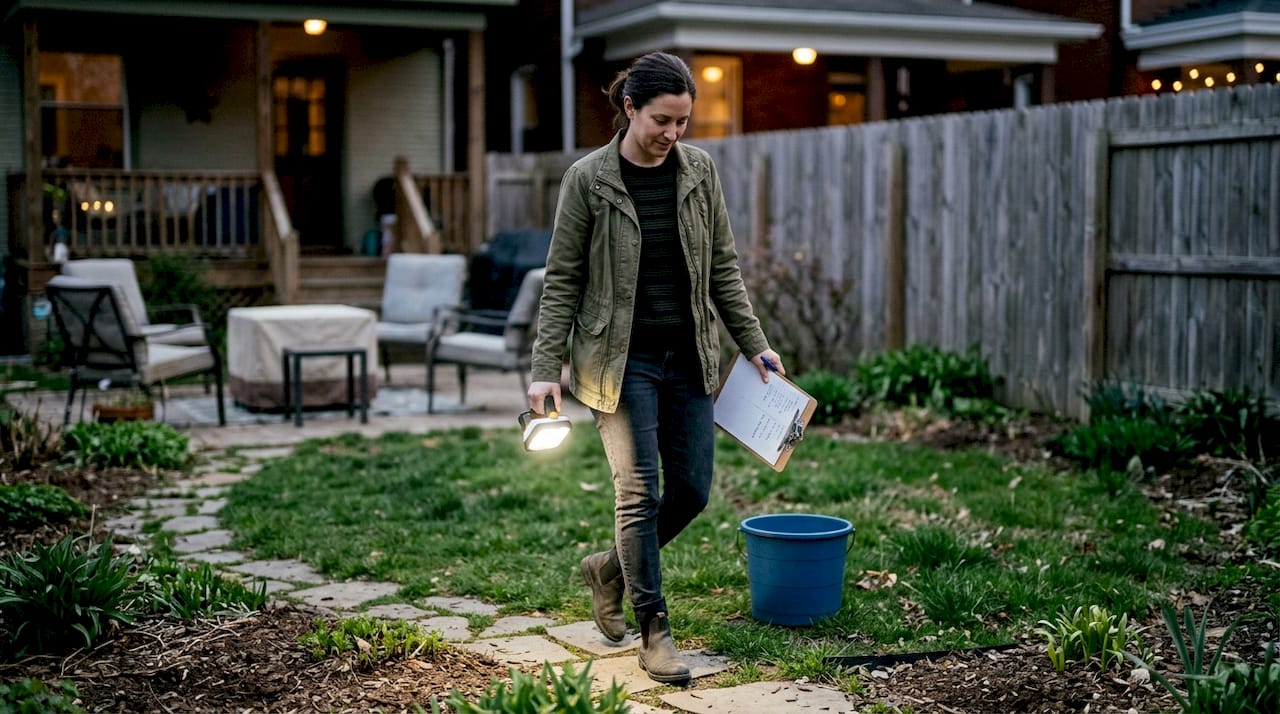
Pro Tip: Before committing to any fixture location, walk your property at night with a portable LED work light. Hold it in position and see how the light falls. This simple step saves you from expensive do-overs.
Avoiding these lighting mistakes makes an enormous difference in the final result. Energy efficiency is another factor worth taking seriously from the start. LED fixtures use a fraction of the energy of older halogen or incandescent options, and smart home lighting ideas like timers, dimmers, and motion sensors give you precise control without wasting electricity. Understanding how light affects color also helps you choose fixtures that render your home's exterior materials accurately instead of making them look washed out or artificially tinted.
Balancing aesthetics and safety: Practical solutions
One of the most persistent myths in outdoor lighting is that brighter automatically means safer. It doesn't. Poorly aimed bright lights create glare that actually reduces visibility, and over-lit yards disturb neighbors, attract insects, and contribute to light pollution in Pittsburgh's residential neighborhoods. The real goal is deliberate balance.
According to experts on outdoor lighting trends, dramatic uplighting can look stunning in theory but regularly causes glare and light pollution in practice. The "less is more" philosophy consistently produces results that are both safer and more visually sophisticated. Dark-sky compliant fixtures, which shield the light source and direct illumination downward, solve multiple problems at once. They reduce glare, eliminate upward light spill, protect the night sky, and often look cleaner and more intentional than standard fixtures.
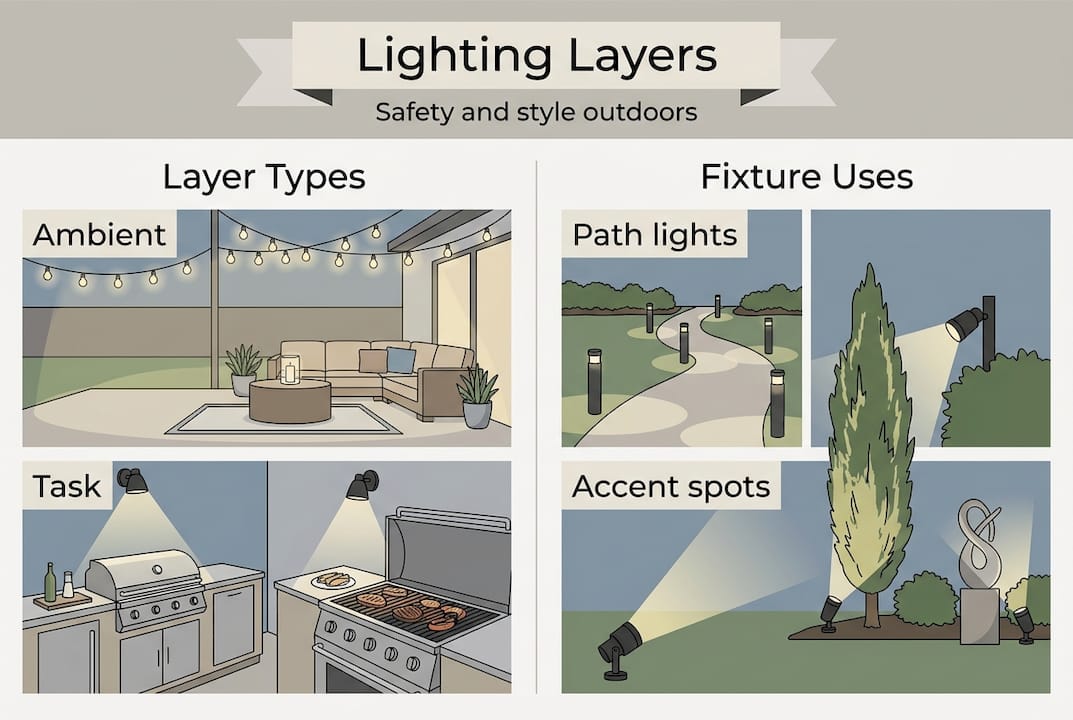
A layered approach is the most effective framework for combining aesthetics and safety. Think of your outdoor lighting in three distinct layers:
- Path and step lighting: These fixtures guide safe movement and prevent trips and falls. They should be subtle, consistent, and positioned at knee height or below.
- Accent lighting: Uplights, well lights, and spotlights draw attention to trees, shrubs, architectural details, and focal points. These create the drama and visual interest.
- Flood and area lighting: Broader coverage for driveways, garage areas, and wide open spaces. These prioritize safety and visibility over aesthetics but should still be aimed carefully.
Pro Tip: Use warm white (2700K to 3000K) across all three layers for visual harmony. Switching between warm and cool fixtures in the same outdoor space creates a chaotic, unfinished look that undermines all your other design decisions.
Here's a practical comparison of common fixture options to help you choose:
| Fixture type | Best use | Aesthetic effect | Safety value |
|---|---|---|---|
| Path lights | Walkways, garden borders | Soft, ground-level glow | High for foot traffic |
| Uplights | Trees, walls, focal features | Dramatic, textured shadows | Low (accent only) |
| Well lights | Flush with ground, accent | Clean, hidden source | Medium |
| Floodlights | Driveways, wide open areas | Broad, utilitarian | Very high |
| Step lights | Stairs, raised entries | Subtle, integrated | Very high |
When you landscape lighting projects are designed with this layered structure in mind, the results feel intentional rather than improvised. You can also illuminate building exteriors for stunning curb appeal by using shielded fixtures that direct light precisely where you want it. Choosing energy efficient fixture options means you can run lights longer without worrying about electricity costs, which matters in Pittsburgh winters when darkness arrives early.
Applying lighting design for Pittsburgh homes: A step-by-step approach
Pittsburgh's climate and architecture present specific opportunities and challenges. The wet winters, humid summers, and dramatic seasonal changes mean fixture durability matters as much as design. The region's abundance of mature trees, sloped yards, and distinctive home styles, from classic brick Colonials in Squirrel Hill to Craftsman bungalows in Lawrenceville, give you incredible material to work with when you approach lighting design thoughtfully.
Following a clear process makes the difference between a project that looks professional and one that looks patched together. According to the core principles of lighting design, every successful outdoor lighting plan balances function, mood, aesthetics, and safety from the very first planning conversation.
Here's how to approach it step by step:
- Assess your property at night: Walk outside after dark and take photos. Note where you feel unsafe, where your home looks underwhelming, and where natural focal points already exist in your landscaping or architecture.
- Define your priorities: Decide whether safety, aesthetics, or both are driving the project. This shapes every fixture selection and placement decision that follows.
- Choose weather-rated fixtures: Pittsburgh's freeze-thaw cycles are hard on outdoor equipment. Look for fixtures rated IP65 or higher for water and dust resistance, and choose materials like brass, copper, or quality powder-coated aluminum that hold up over years.
- Plan consistent color temperature: Select all your fixtures before purchasing to confirm they share the same color temperature. Warm white (2700K to 3000K) works for most Pittsburgh homes. Lock in that number and don't deviate.
- Test before you commit: Place fixtures in their planned positions and observe the result from multiple angles at night. Walk every path. Stand at the street and evaluate curb appeal. Make adjustments before any wiring is finalized.
- Add motion-activated lighting strategically: Motion sensors on key fixtures add both security and energy efficiency. They're especially effective at garage areas, side yards, and rear entries where activity is intermittent.
Here's a practical data reference for common Pittsburgh outdoor lighting scenarios:
| Scenario | Recommended lumen range | Suggested color temp | Fixture category |
|---|---|---|---|
| Front walkway (10 ft long) | 50 to 150 lumens per fixture | 2700K | Path lights |
| Tree uplight (medium tree) | 200 to 400 lumens | 3000K | Well light or uplight |
| Garage or driveway area | 700 to 1300 lumens | 3000K | Floodlight |
| Entry door accent | 100 to 300 lumens | 2700K | Wall sconce |
| Rear patio ambient | 300 to 700 lumens | 2700K | String or post lights |
These ranges give you a starting point, but real placement decisions always require that nighttime walk-through before anything is finalized. Every property is different, and Pittsburgh's varied topography means what works on a flat lot in the North Hills may need adjustment for a sloped yard in Mt. Lebanon.
Why less is more: Local insights from Pittsburgh lighting experts
Here's the perspective that most online guides won't tell you: more lights almost always produce worse results. We see it consistently across Pittsburgh properties. Homeowners start with a modest plan, then keep adding fixtures because they're worried about dark spots, and they end up with a yard that looks over-lit, exhausting to look at, and somehow less safe than before.
Pittsburgh's landscape is rich. The hills, the mature canopy, the distinctive architecture, all of it benefits from lighting that reveals rather than overwhelms. When you over-light a space, you eliminate the shadows that give surfaces depth and texture. The result is a yard that looks flat and commercial instead of residential and welcoming.
The outdoor lighting benefits that matter most to Pittsburgh homeowners, safety, curb appeal, and energy efficiency, are all achieved more reliably through restraint and quality than through volume. Dark-sky compliant shielded fixtures are increasingly the choice of experienced designers, and for good reason. As experts note on outdoor lighting trends, dramatic uplighting may impress in showroom photos but routinely causes glare and light pollution in real residential settings.
Our advice: choose fewer, better fixtures. Place them with intention. Test them thoroughly at night. Then stop. The homes that draw the most admiration after dark are almost never the ones with the most fixtures.
Transform your Pittsburgh home with expert lighting solutions
Knowing the principles is one thing. Executing them flawlessly across a real Pittsburgh property is where professional expertise makes the difference.

At Myriad Lighting, we specialize in outdoor lighting design and installation built specifically for Pittsburgh homes and conditions. Our team handles everything from initial consultation and design planning to hidden wiring, professional installation, and final nighttime setup to ensure every fixture performs exactly as intended. Whether you're looking for landscape lighting that highlights your best outdoor features year-round or seasonal holiday lighting that makes your home the standout on the street, we bring both the technical knowledge and the artistic eye to get it right. Reach out to schedule a consultation and see what a thoughtful lighting design can do for your property.
Frequently asked questions
What is lighting design and why does it matter for outdoor spaces?
Lighting design is the strategic planning and use of light to enhance function, mood, aesthetics, and safety, making your outdoor spaces more beautiful and secure at the same time.
How can I prevent glare and light pollution in my outdoor lighting?
Use shielded, dark-sky compliant fixtures and avoid dramatic uplighting aimed at the sky. Always test placement at night to minimize glare before finalizing any installation.
What color temperature is best for outdoor lighting in Pittsburgh?
Experts recommend warm white (2700 to 3000K) for outdoor spaces because it provides visual comfort, design consistency, and a natural look that complements most Pittsburgh home styles.
What steps should I follow to upgrade my outdoor lighting?
Assess your property at night, choose weather-resistant and energy-efficient fixtures, plan for consistent color temperature, and always test placement after dark before committing to final wiring and installation.