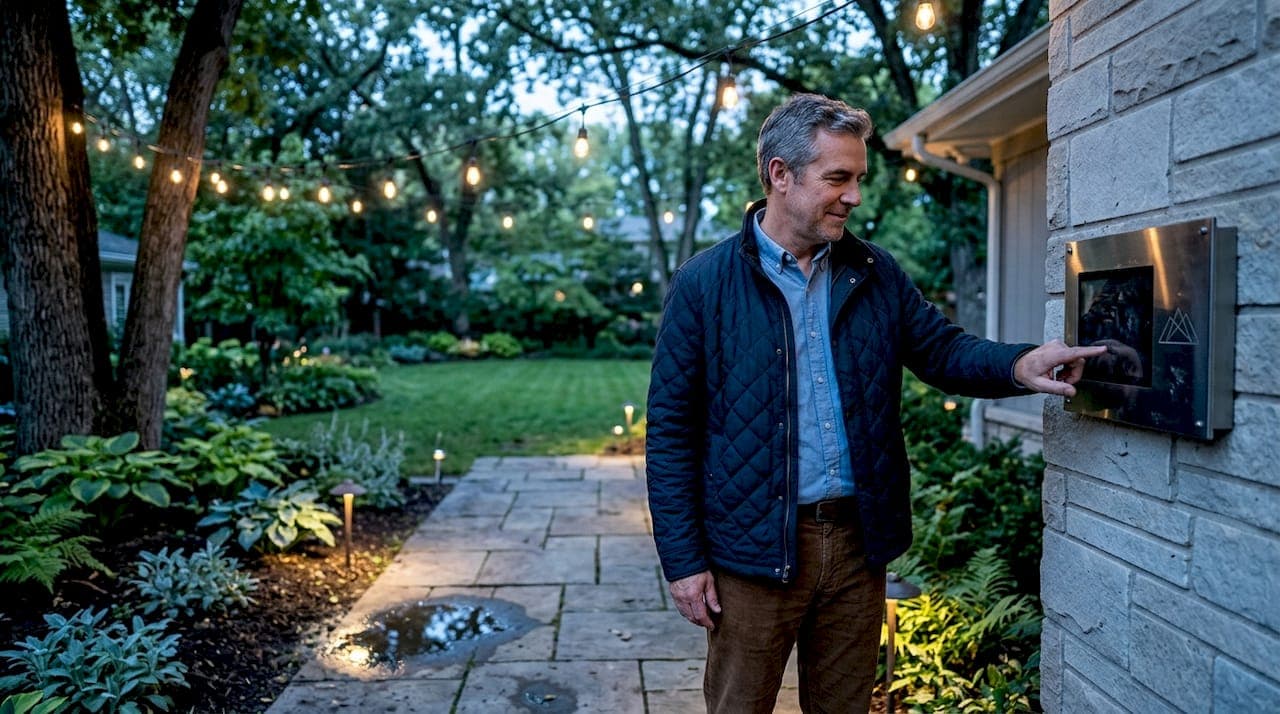
You walk inside after a long day, and your outdoor lights blaze away all night — burning electricity, attracting bugs, and doing nothing useful after midnight. It's one of the most common complaints Pittsburgh homeowners share when they finally call us. Lighting controls are devices and systems that automatically adjust lighting levels, turn lights on or off, or dim them based on occupancy, time, daylight, or user input. They solve wasted energy, security gaps, and inconsistent illumination in one elegant move. This article breaks down exactly what lighting controls are, which types work best for Pittsburgh homes, and how to use them to boost both safety and curb appeal.
Table of Contents
- What are lighting controls?
- Key types of lighting controls for homeowners
- Expert tips for effective outdoor lighting controls in Pittsburgh
- How lighting controls boost security, curb appeal, and savings
- The hidden advantage of lighting controls: Beyond the basics
- Ready to enhance your outdoors with smart lighting?
- Frequently asked questions
Key Takeaways
| Point | Details |
|---|---|
| Automate outdoor lighting | Lighting controls such as timers and sensors provide hands-free security and convenience for your home. |
| Save energy and costs | Automatic shutoff and dimming with controls can significantly reduce electricity use. |
| Boost safety and curb appeal | Strategic use of controls makes outdoor spaces safer and highlights landscaping after dark. |
| Adapt for Pittsburgh weather | Choose weatherproof controls and lux sensors to suit local conditions for year-round performance. |
What are lighting controls?
Think of lighting controls as the brain behind your outdoor lighting system. Without them, your lights are just static fixtures that you manually switch on and off. With them, your entire exterior becomes a responsive, intelligent system that reacts to conditions and your schedule.
Lighting controls automatically adjust brightness levels, switch lights on or off, or dim them based on occupancy, time of day, available daylight, or direct user input. That means your pathway lights come on exactly at dusk without you touching a switch, your driveway floods with light the moment someone pulls in, and your accent lighting dims after 11 p.m. so you're not bothering neighbors.
Here's why Pittsburgh homeowners are increasingly interested in them:
- Energy savings: Lights that only run when needed cost far less to operate than fixtures left on all night.
- Enhanced security: Automated lighting removes the human error of forgetting to turn on entryway lights.
- Curb appeal: Dimming and timed controls let you create dramatic visual effects that elevate your home's exterior after dark.
- Property value: Homes with smart exterior lighting systems are increasingly attractive to buyers who want modern, efficient properties.
"The best outdoor lighting design is one you never have to think about. It just works — protecting your home, impressing guests, and saving you money, all at the same time."
Beyond convenience, lighting controls are foundational to nightscape lighting benefits that go far beyond simple aesthetics. When you pair thoughtful design with smart controls, your home's exterior transforms into something genuinely stunning. For broader inspiration on how smart lighting integrates into your living environment, exploring smart home lighting ideas can open your eyes to possibilities you may not have considered.
Key types of lighting controls for homeowners
Now that you know why lighting controls matter, let's break down the types that make a real difference for Pittsburgh homes. Each control type serves a specific purpose, and understanding the differences helps you build a system that truly fits your property.
Key types for homeowners include dimmers for variable brightness and energy savings, motion sensors for automatic on and off based on movement, occupancy sensors that detect whether a space is in use, photosensors that respond to natural light levels, and timers that run lights on a fixed schedule. Here's a side by side comparison to help you decide:
| Control Type | How It Works | Best Use Case | Energy Savings |
|---|---|---|---|
| Dimmer | Reduces voltage to lower brightness | Accent and landscape lighting | Moderate |
| Motion sensor | Activates on detected movement | Driveways, entryways, dark pathways | High |
| Occupancy sensor | Detects sustained presence in a zone | Covered porches, garages | High |
| Photosensor | Responds to ambient light levels | Dusk to dawn pathway lighting | Very high |
| Timer | Runs on a fixed on/off schedule | Holiday lighting, front door fixtures | Moderate |
For Pittsburgh homes specifically, the combination of motion sensors and photosensors is particularly powerful for dark driveways and long pathways. Motion sensors handle security and convenience, while photosensors ensure lights only activate after true darkness falls, not just when a cloud passes overhead. This pairing eliminates the guesswork entirely.
Pro Tip: Don't rely on timers alone for Pittsburgh. Our seasons shift dramatically, and a timer set for a September sunset will either fire too early or too late by December. Photosensors self adjust to actual daylight conditions, which is far more reliable year round.
For specific guidance on getting motion-activated lighting right, there's a lot more nuance than simply pointing a sensor at your driveway. Placement, detection angle, and sensitivity settings all matter. If you're also thinking about how to use natural daylight strategically alongside your artificial lighting, these maximizing natural light tips offer a useful complementary perspective.
A few key points to remember when mixing control types:
- Layer your controls: Use photosensors for automatic dusk to dawn activation, then add motion sensors for security zones on top.
- Zone your property: Front yard, backyard, driveway, and entryway all have different needs and benefit from different control strategies.
- Avoid over controlling: Not every fixture needs every control type. Simplicity in the right zones prevents system confusion and maintenance headaches.
Expert tips for effective outdoor lighting controls in Pittsburgh
Knowing the types of lighting controls is just the start. Here's how to get it right for Pittsburgh's unique weather and landscape, where seasons swing hard and conditions can change overnight.
1. Choose lux sensors over basic timers for daylight response. Pittsburgh's weather is famously variable. We get overcast stretches in January that last weeks, and summer storms that darken skies at 4 p.m. A timer doesn't know any of this. A lux sensor (which measures actual light intensity, or "lux," in the environment) responds to real conditions, switching lights on when it gets genuinely dark rather than at an arbitrary clock time.
2. Place sensors strategically, away from competing light sources. Sensor placement is critical because direct glare or reflected light can confuse photosensors into thinking it's daytime when it isn't. Mount photosensors on north facing surfaces where possible, away from streetlights and your own fixture output. For occupancy sensors, position them to cover the full detection zone without interference.
3. Require IP44 or higher weather ratings for all outdoor controls. Pittsburgh winters include freezing rain, heavy snow, and freeze thaw cycles that destroy unrated hardware quickly. IP44+ rated fixtures protect against splashing water from any direction and particulate matter. For fixtures near ground level or in exposed locations, IP65 or higher is even better.
4. Set deadbands and time delays to prevent nuisance flickering. A deadband is a small buffer zone in a sensor's detection threshold that prevents it from rapidly switching on and off when conditions hover near the trigger point. Without a deadband, a photosensor on a partly cloudy day can flicker your lights repeatedly as clouds drift past. Most quality controls allow you to set this buffer during installation.
5. Test before finalizing installation. Walk your property at night after a rough installation and note where shadows fall, where glare hits, and where coverage gaps exist. Adjust sensor angles and sensitivity settings before calling the job done.
Pro Tip: Consider pool lighting safety tips if your Pittsburgh property has water features. Moisture near electrical controls requires extra precautions, and the principles for weatherproofing apply equally here.
Avoiding common outdoor lighting mistakes often comes down to the details most homeowners overlook at the planning stage. The right control system handles 90% of those mistakes automatically, but only if it's installed correctly from the start.
How lighting controls boost security, curb appeal, and savings
You understand the technologies, so what real life impact do lighting controls make for you in Pittsburgh? Let's look at three concrete areas where the right controls deliver measurable results.
Security
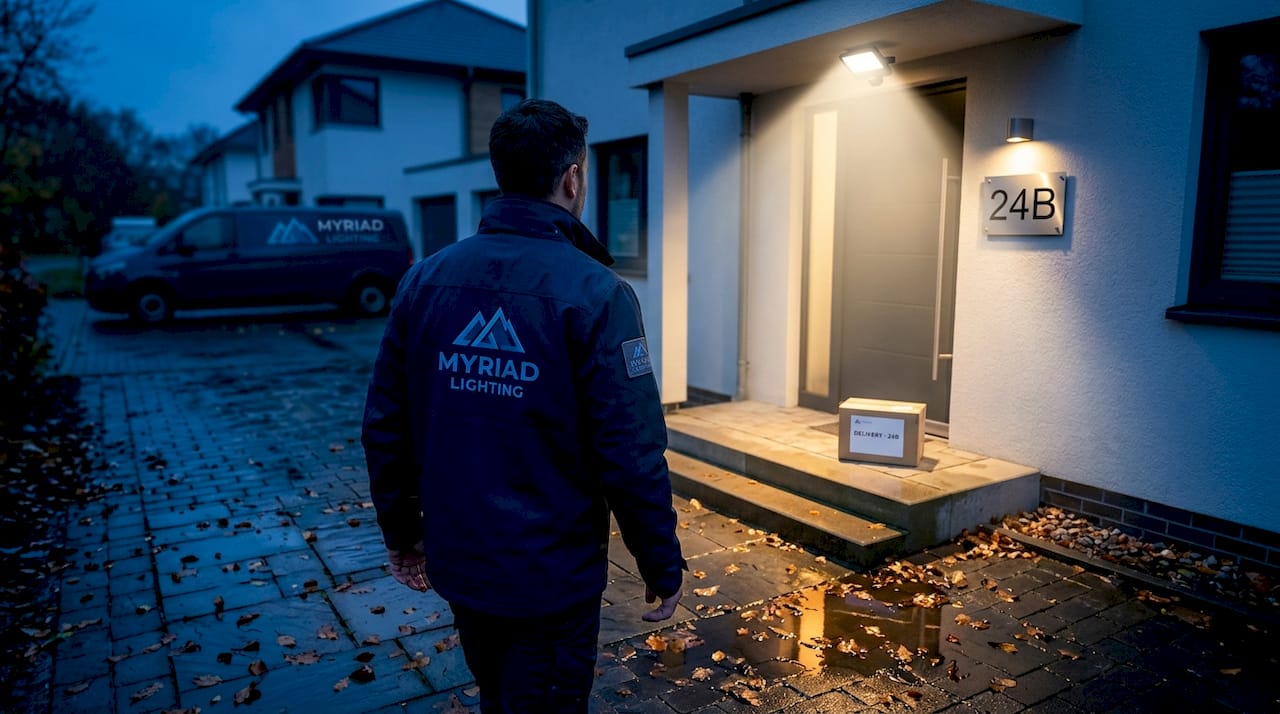
Motion sensors are among the most effective deterrents available to homeowners. When someone approaches your driveway or side gate, a sudden flood of light signals that the property is monitored and active. Importantly, motion sensors for outdoor security paired with photosensors create a smarter system: lights activate on motion only after dark, not every time a squirrel runs past at noon.
This approach keeps entryways lit only when genuinely needed, which also prevents the habituation effect where neighbors stop noticing a light that burns constantly. An unexpected burst of bright light is far more alarming to an intruder than a porch light that never changes.
Curb appeal
Dimmers and timers give you precise creative control over how your home presents itself after dark. You can program accent lights on trees and architectural features to run at full brightness during evening hours, then step down to 30% after 10 p.m. for a softer, more neighborhood friendly glow. Timers tied to seasonal schedules also make it effortless to shift your lighting personality from summer entertaining mode to winter holiday display.
"Curb appeal isn't just about what your home looks like at noon. The evening presentation often makes a stronger impression on guests, buyers, and even yourself as you pull into the driveway."
The work we do illuminating building exteriors demonstrates just how dramatically the right controlled lighting transforms a property after dark. For ideas on creating atmospheric effects with your lighting, these mood lighting ideas offer practical inspiration you can adapt for outdoor use.
Energy savings: sensor vs. manual comparison
| Lighting Approach | Avg. Hours On Per Night | Est. Monthly Cost (12 fixtures) | Annual Savings vs. Manual |
|---|---|---|---|
| Manual (always on) | 10 hours | ~$28 | Baseline |
| Timer controlled | 7 hours | ~$20 | ~$96/year |
| Motion + photosensor | 3 hours active | ~$9 | ~$228/year |
| Hybrid (all controls) | 2.5 hours active | ~$7.50 | ~$246/year |
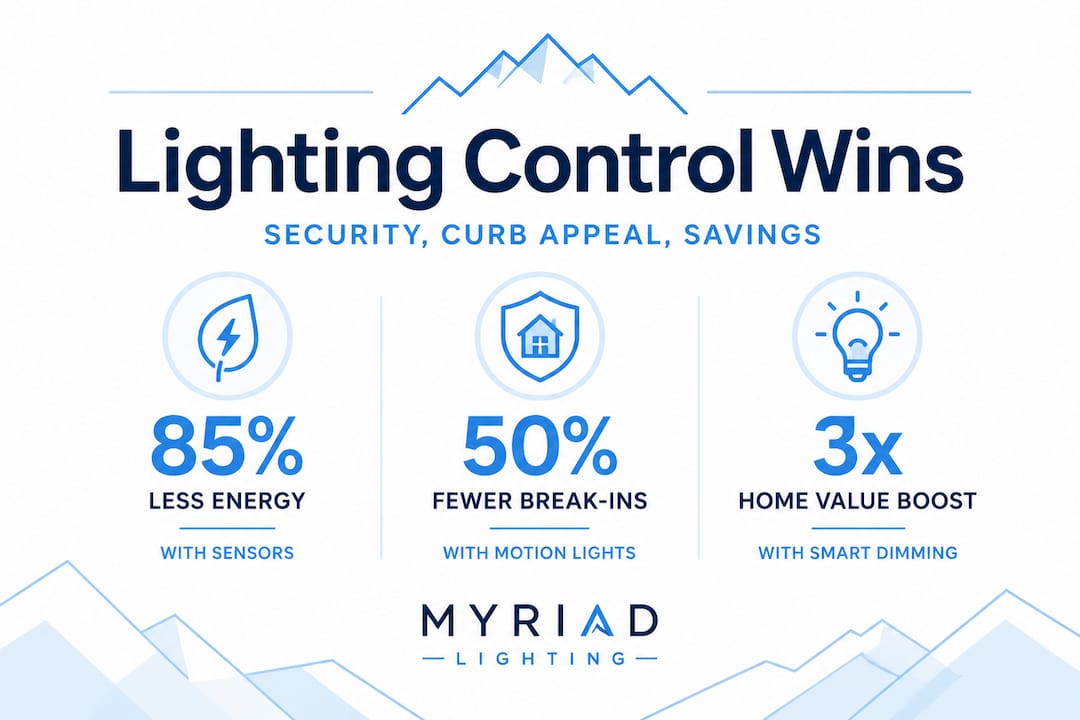
The numbers tell a clear story. A hybrid setup using motion sensors, photosensors, and dimmers for a typical Pittsburgh home's exterior lighting can save over $200 annually while delivering better security and aesthetics than a lights on all night approach ever could.
The hidden advantage of lighting controls: Beyond the basics
Here's something most homeowners and even some lighting installers overlook: lighting controls aren't just about convenience and savings. They're one of the most effective tools for managing light pollution and over brightness, two problems that quietly undermine the quality of your outdoor lighting design.
Over bright outdoor lighting washes out your own landscaping. When fixtures run at full power all night with no dimming or scheduling, everything begins to look flat and overexposed. The shadows that create depth and drama in a well lit garden disappear. You end up with a flood lit yard that looks like a parking lot rather than a carefully designed exterior. Expert guidance on outdoor night lighting consistently recommends testing light baselines before installation, using lux sensors for environments like Pittsburgh where daylight is highly variable, and aiming fixtures downward to minimize sky glow and light trespass onto neighboring properties.
What we see repeatedly in professional installations is that the most beautiful results come from ongoing adjustment, not a single setup and done approach. Your home looks different in summer foliage versus winter bare branches. Holiday decorations change how light interacts with your roofline. A great outdoor lighting design is a living system, and lighting controls are what make it adaptable.
The real mistake most homeowners make is treating controls as a set it and forget it feature. They install a photosensor, walk away, and assume the job is done. In reality, revisiting your sensitivity settings seasonally, adjusting timer schedules twice a year, and checking sensor placement after major landscaping changes are all part of getting real long term value from your investment. The homes with genuinely stunning outdoor lighting after five years are the ones whose owners treat the lighting system as something worth maintaining and refining, not just installing.
Ready to enhance your outdoors with smart lighting?
With a clear picture of how lighting controls work and what they can do for your Pittsburgh home, the next step is putting that knowledge into action with professional guidance.

At Myriad Lighting, we design and install lighting control systems tailored specifically to Pittsburgh homes, accounting for our unique seasonal conditions, property layouts, and your personal goals for security and aesthetics. Our team handles sensor placement, weatherproofing, and fine tuning so your system performs exactly as intended from day one. Whether you're starting with landscape lighting services or adding intelligent controls to a full exterior display including our holiday lighting experts team, we make sure every fixture and control works together seamlessly. Schedule a consultation and let us show you what truly smart outdoor lighting looks like.
Frequently asked questions
Which lighting controls save the most energy outdoors?
Motion sensors and photosensors deliver the greatest savings by activating outdoor lights only when movement is detected or natural light drops below a set threshold, keeping unnecessary runtime to a minimum.
How do I choose the right lighting controls for my yard?
Match the control type to your goal: dimmers for ambiance, motion sensors for security zones, and photosensors or timers for reliable automated scheduling along pathways and entryways.
Are lighting controls weatherproof for Pittsburgh conditions?
Always specify IP44 or higher ratings for any outdoor control hardware in Pittsburgh, and consider IP65 for fixtures in exposed or low mounted locations subject to direct snow and freezing rain.
Can I combine different lighting controls?
Absolutely. Pairing motion sensors with timers and dimmers is the most flexible approach, giving you security triggered activation, scheduled on and off windows, and adjustable brightness all working together in one coordinated system.