
Outdoor lighting is one of those things Pittsburgh homeowners tend to underestimate. Most people assume it's mainly about curb appeal, maybe a few path lights to look nice after dark. But the reality is more striking: functional outdoor lighting prioritizes utility for safety, security, and navigation over pure aesthetics. The right setup actively prevents trips and falls, deters trespassers, and guides your family safely from the driveway to your front door. This guide breaks down exactly what functional outdoor lighting means, compares your best options, covers installation best practices, and flags the mistakes that cost Pittsburgh homeowners time and money.
Table of Contents
- Defining functional outdoor lighting: Safety, security, and utility
- Types of functional outdoor lighting and their uses
- Best practices for installing functional outdoor lighting in Pittsburgh
- Balancing function and aesthetics: Tips for Pittsburgh homes
- What most homeowners miss about functional outdoor lighting
- Ready to transform your outdoors? Expert help for Pittsburgh homes
- Frequently asked questions
Key Takeaways
| Point | Details |
|---|---|
| Function means safety | Functional outdoor lighting ensures you can safely navigate and use outdoor spaces after dark. |
| Effective fixture choices | Selecting the right fixtures for climate and code compliance maximizes both security and curb appeal. |
| Plan before installing | Upfront design and understanding local ordinances prevent common mistakes and wasted effort. |
| Balance look and utility | Thoughtful installation blends usefulness with aesthetic value for the best outdoor experience. |
Defining functional outdoor lighting: Safety, security, and utility
Once you understand why functional outdoor lighting matters, it's important to clarify the fundamentals and see how they differ from more decorative choices.
Functional outdoor lighting is designed with a clear mission. It illuminates paths, entrances, driveways, and activity areas to prevent accidents and deter intruders. That's the core definition. It's not about creating a dramatic Instagram-worthy facade. It's about making sure you can safely reach your front door on a rainy Pittsburgh night in November, that a delivery driver doesn't trip on your unlit porch steps, and that a would-be intruder doesn't find a dark corner to linger in.
Decorative lighting focuses on ambiance and style. Functional lighting focuses on usability. The best residential setups blend both, but function should always come first. Think of it this way: a beautifully lit garden that leaves your front walkway in shadow has failed its most important job.
Key areas every Pittsburgh home should address with functional lighting:
- Front entrances and doorways
- Walkways and sidewalks
- Driveways and garage areas
- Patio and deck spaces
- Stairs and grade changes
- Side yards and back entries
Pittsburgh's climate adds extra urgency here. Wet leaves in October, ice patches in January, and heavy spring rains create real slip hazards. Older Pittsburgh home styles, like Craftsman bungalows and brick rowhouses, often feature steep steps, narrow side yards, and deep front porches that create natural shadow zones. Addressing those zones isn't optional if you care about safety.
| Priority zone | Primary function | Lighting concern |
|---|---|---|
| Front entrance | Safe entry, security | Visibility, intruder deterrence |
| Walkway | Navigation, fall prevention | Even coverage, no dark gaps |
| Driveway | Vehicle and foot safety | Brightness without glare |
| Stairs | Fall prevention | Step-level illumination |
| Patio/deck | Activity and visibility | Usable light for tasks |
For deeper perspective on enhancing home safety through lighting design, the connection between well-placed fixtures and accident prevention is well documented. You should also explore motion-activated options for areas that don't need constant illumination but benefit from on-demand brightness.
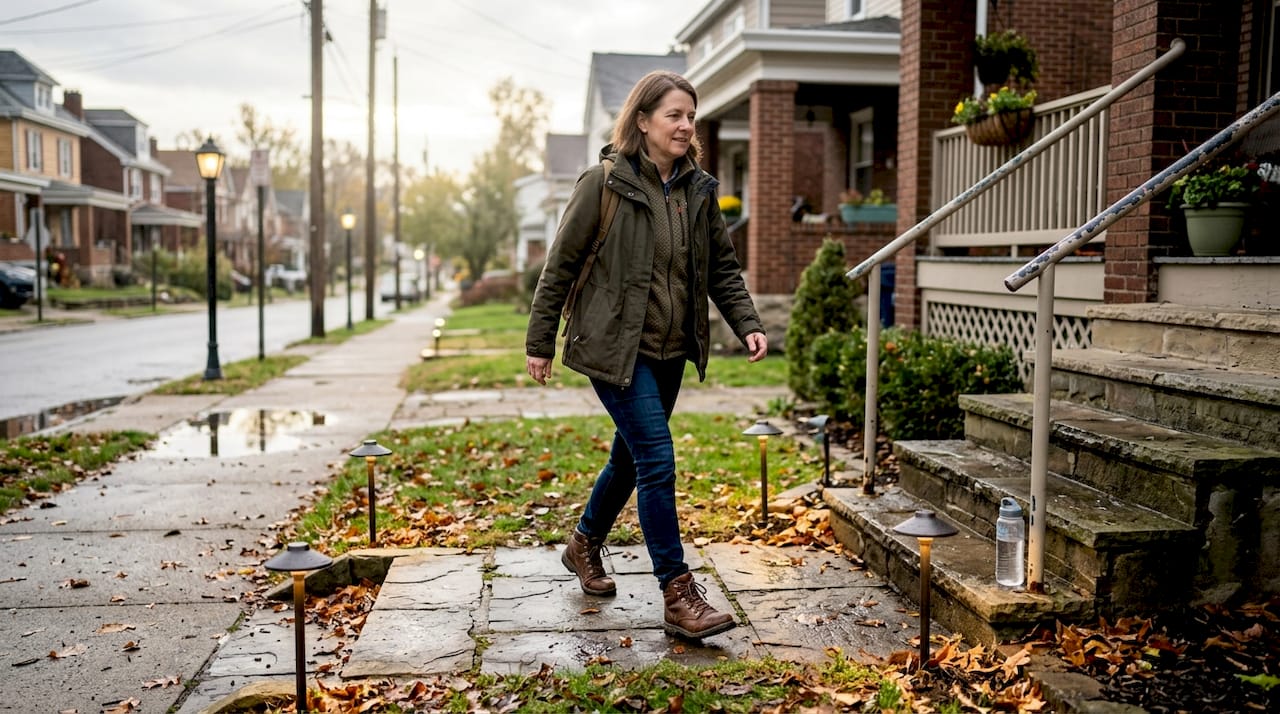
Pro Tip: Start your lighting plan by walking your property after dark. Note every shadow, every tripping hazard, and every entry point that feels exposed. That walk tells you exactly where functional lighting is missing.
When you approach landscape lighting solutions with function first, the aesthetic rewards follow naturally.
Types of functional outdoor lighting and their uses
Having defined functional outdoor lighting, let's examine the specific types and how each delivers utility for your home.
Not every fixture does the same job. Matching the right type to the right location is what separates a lighting plan that works from one that just looks busy.
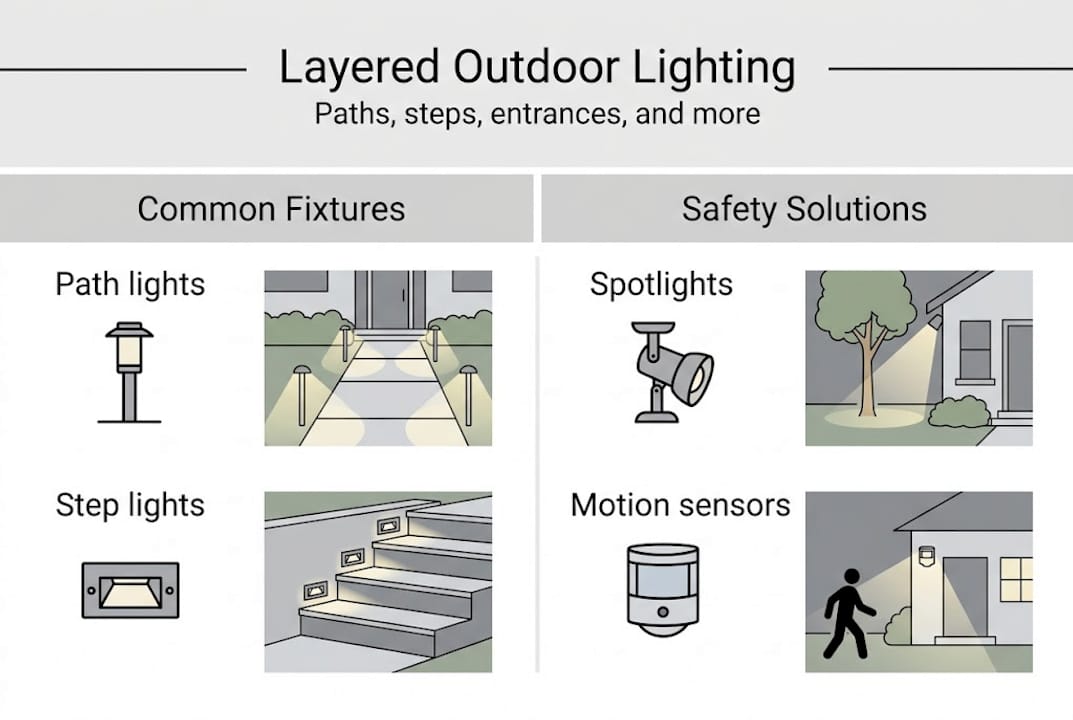
1. Path lights sit low to the ground and cast downward light along walkways. They guide foot traffic without creating glare.
2. Step lights mount directly into risers or retaining walls. They're essential for Pittsburgh homes with front stoop stairs.
3. Spotlights and floodlights provide targeted or wide-area brightness. Spots highlight specific features; floods cover large zones like driveways and backyards.
4. Wall-mounted fixtures flank entryways and garage doors. They combine strong task lighting with a finished architectural look.
5. Motion-sensor fixtures activate when movement is detected. They're especially effective for side yards and back entries that you don't want lit all night.
Layering these types strategically is where the real results happen. Layered lighting creates depth, while full-cutoff fixtures reduce light pollution but may require more placement points. Layering isn't about adding more fixtures. It's about using different fixture types together so every zone has the right kind of light for its purpose.
| Power source | Reliability | Installation effort | Best use case |
|---|---|---|---|
| Hardwired low-voltage | High | Professional recommended | Permanent, high-use zones |
| Solar | Weather-dependent | DIY-friendly | Low-traffic accent areas |
| Portable/plug-in | Low | Minimal | Temporary or seasonal use |
For Pittsburgh homes, hardwired low-voltage LED systems are almost always the right call for functional areas. Solar performance drops significantly in overcast Pittsburgh winters. Portable options simply can't be relied on for safety-critical locations.
Pro Tip: Avoid using only one type of fixture throughout your yard. Combining step lights with wall-mounted fixtures and path lights creates layers that eliminate shadow zones completely.
For ideas on how professional-grade choices elevate results, explore professional design features that go beyond basic fixture selection.
Best practices for installing functional outdoor lighting in Pittsburgh
Now that you know the types of functional lighting, it's critical to get installation right for safety, compliance, and beautiful results.
Installation is where most DIY outdoor lighting projects fall apart. The fixtures look fine at the store. Then they get placed incorrectly, wired improperly, or chosen without regard for local codes. Here's how to avoid those pitfalls.
Before you install anything, check your local ordinances. Pittsburgh-area codes require shielded fixtures in many municipalities, and neighboring areas like Greensburg mandate full-shielded fixtures to manage light pollution. Ignoring this can result in required fixture replacements after the fact.
Key installation best practices:
- Use weatherproof-rated fixtures with IP65 or higher ratings for Pittsburgh's wet and icy conditions
- Bury low-voltage wiring at least 6 inches deep to protect from freeze-thaw ground movement
- Position wall-mounted fixtures at 6 to 7 feet high for best coverage without glare
- Space path lights 8 to 10 feet apart for even coverage without over-lighting
- Use timers and smart controls to minimize energy use and automate operation
- Test every fixture placement after dark before finalizing wiring runs
"The most common installation mistake we see is homeowners placing fixtures based on how they look during the day. Functional lighting has to be evaluated at night, in the dark, from the perspective of someone actually moving through the space."
For lighting design guidance, energy-efficient LED choices paired with smart controls offer the best long-term performance for Pittsburgh's variable climate. Integrating timers and dusk-to-dawn sensors means your functional zones are always lit when needed without running up your utility bill unnecessarily.
For homeowners working on lighting for curb appeal, the same principles apply. Function and beauty share the same foundation: precise placement and quality fixtures.
Pro Tip: Before finalizing any installation, review this checklist of outdoor lighting mistakes that Pittsburgh homeowners most often make. Avoiding them upfront saves significant rework.
Balancing function and aesthetics: Tips for Pittsburgh homes
With the technical aspects covered, let's explore creative strategies to combine safety and visual appeal in Pittsburgh homes.
Functional lighting doesn't have to look utilitarian. The best outdoor lighting setups in Pittsburgh neighborhoods do both jobs so well that most people can't tell where safety ends and beauty begins.
Strategies that work:
- Use warm white LEDs (2700K to 3000K) for entrances and walkways. They feel welcoming and render faces naturally, which matters for security cameras too.
- Direct fixtures downward and inward to eliminate upward light scatter and glare for neighbors.
- Layer accent lighting on architectural features behind functional path and step lighting to add depth without sacrificing safety.
- Choose fixtures that match your home's architectural character. A Craftsman-style bungalow in Squirrel Hill looks best with bronze or dark-finished fixtures, not chrome.
- Use beam angles strategically: narrow beams for focal points, wide beams for open zones like driveways.
Functional lighting can minimize glare and light pollution while still enhancing the beauty of house and landscape features. This matters especially in Pittsburgh's densely spaced neighborhoods where your lights affect your neighbors just as much as they affect your own property.
A well-executed lighting plan can increase perceived property value and reduce on-site accidents, two outcomes that matter to every homeowner. Buyers notice curb appeal immediately, and a safe, well-lit exterior signals that the property is cared for.
For a closer look at how quality lighting impact translates into real property value and daily livability, the connection is consistent across residential markets.
Avoid the temptation to flood every surface with light. Brightness without direction creates glare, eliminates contrast, and actually makes it harder to see clearly. Purposeful restraint, bright where it counts and dark where it doesn't, is the mark of a well-designed lighting plan.
What most homeowners miss about functional outdoor lighting
Here's what we've seen repeatedly working with Pittsburgh homeowners: people tend to invest heavily in one direction or the other. Either they go all-in on security with bright floodlights covering every inch, or they focus entirely on aesthetic drama with uplighting and color effects that look stunning on a summer evening but leave their front walkway dangerously dark.
Both approaches leave real value on the table. The homeowners who get the most out of their outdoor lighting are the ones who refuse to choose between safety and beauty. They treat function and aesthetics as the same goal, not competing priorities.
Over-lighting is a real problem that gets underestimated. Too much light creates glare, reduces depth perception, and generates light pollution that frustrates neighbors and reduces your own enjoyment of your outdoor space. Effective lighting is precise, not powerful.
Design for the people who actually use the space, not just for how the house looks from the street at 10pm. Prioritize the routes your family walks every night, the spots where guests arrive, and the areas where you actually spend time after dark. Exploring nightscape lighting strategies helps illustrate how this people-first approach transforms outdoor spaces in ways that pure security or pure aesthetics thinking never achieves.
Ready to transform your outdoors? Expert help for Pittsburgh homes
To make sure your lighting project is both functional and stunning, professional guidance can make all the difference.
Getting outdoor lighting right in Pittsburgh means accounting for local codes, seasonal weather, your home's architecture, and your family's actual routines. That's a lot to balance on your own, and the margin for error is real.

At Myriad Lighting, we specialize in landscape lighting Pittsburgh homeowners trust for both safety and beauty. Our design process starts with a thorough consultation, covers code-compliant fixture selection, and finishes with professional installation that hides wiring and delivers results that hold up through Pittsburgh winters. We also offer holiday lighting Pittsburgh services that extend your home's seasonal appeal without compromising the functional system underneath. Schedule your free consultation and let's build a lighting plan that actually works for your home.
Frequently asked questions
What is considered functional outdoor lighting?
Functional outdoor lighting is designed for safe navigation, security, and practical utility, illuminating key outdoor areas like entrances, paths, and driveways. It prioritizes utility for safety and security over pure aesthetics.
How does functional outdoor lighting improve home security?
By brightening dark areas and using motion sensors, functional lighting deters intruders and makes it easier to spot suspicious activity around your property. Functional lighting deters intruders while minimizing glare and light pollution.
What types of fixtures are best for Pittsburgh's weather?
Weather-resistant, hardwired low-voltage and full-shielded LED fixtures are ideal because they withstand Pittsburgh's moisture and seasonal changes. Hardwired low-voltage fixtures offer reliability, while properly shielded LEDs control glare and energy use.
Do I need permits or code checks for outdoor lighting in Pittsburgh?
Homeowners should always check local lighting codes; many Pittsburgh-area municipalities require shielded, code-compliant fixtures to reduce light pollution. Local codes vary, and nearby areas like Greensburg specifically require full-shielded fixtures.